

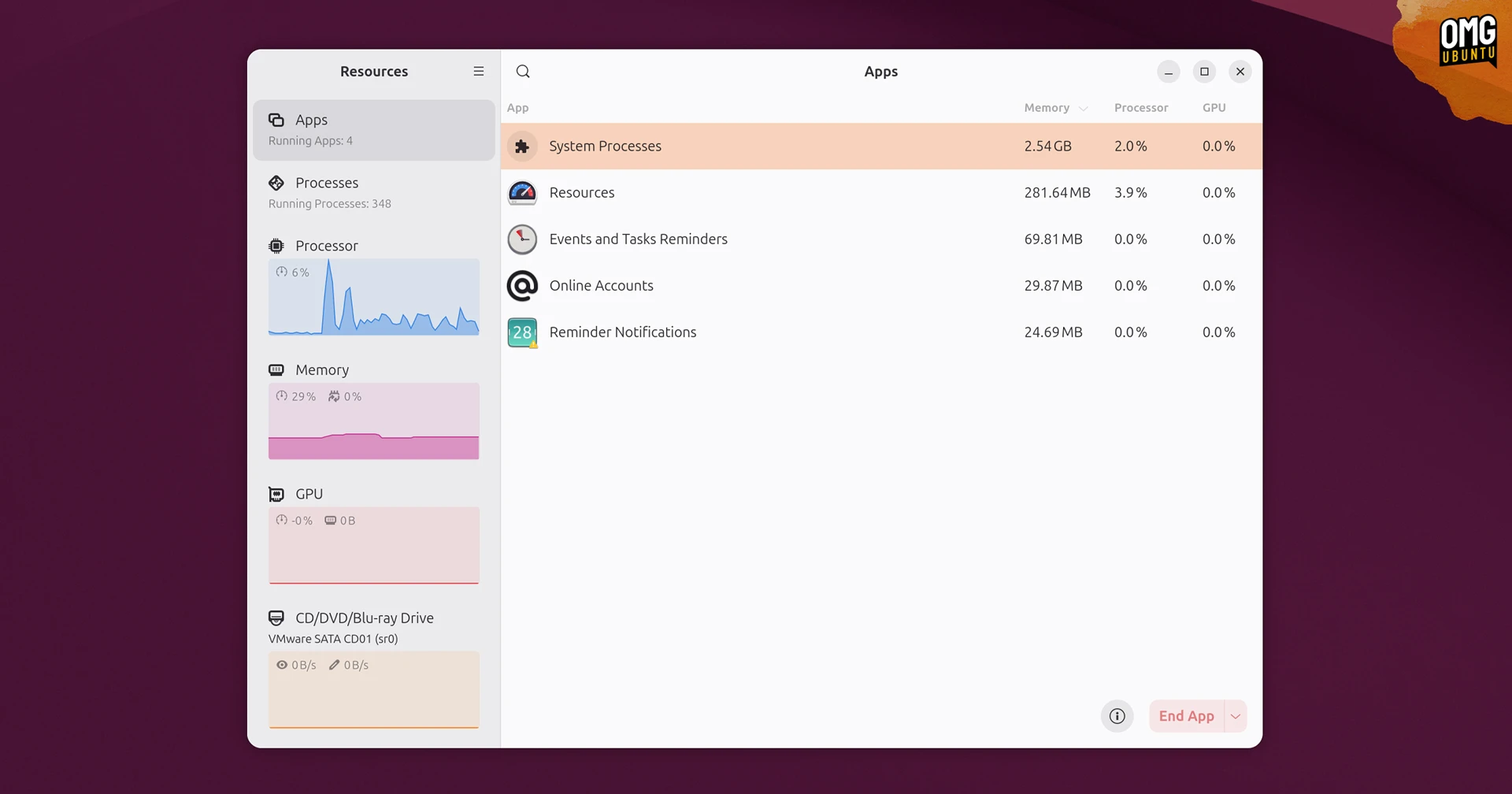
A new version of Resources, the system monitor tool Ubuntu 26.04 LTS made its default, is out with improve AMD NPU reporting and temperature reading for PowerPC CPUs.
Users with Ryzen 7040, 8040 and Ryzen AI 300/400-series chips can see real-time power and performance stats for their onboard neural accelerators in Resources v51 – useful if you want to check that local AI task is using an NPU and not quietly frying your CPU.
And while an eyebrow may cock at the headline mention of “PowerPC”, it’s not as dated as it sounds. This build is able to read PowerPC CPU temps from the Linux kernel’s ibmpowernv hwmon driver, which supports POWER8 and newer chips (not the old ones Apple used to use).
Indeed, PowerPC isn’t dead: IBM still make POWER servers and Raptor Computing sell POWER9 boards (Talos II, Blackbird) that run Linux without proprietary firmware. A niche audience, sure, but the stats are there to be read, so why not: power to Resources’ devs for doing it.
Per the changelog, this version has improved Steam game and Snap app detection and bolstered accessibility .It also lets you show/hide the sidebar by tapping the F9 key.
On the UI side, the sidebar is more “space efficient”, and only shows device descriptions for hardware components if there are multiple instances of a device type. Usage numbers now appear overlaid on graphs in the sidebar, rather than stacked beneath.
New memory metric options in Resources 51
Resources 51 also lets you change how Resources’ memory calculations work. There are new dconf values for /org/gnome/Resources/memory-metric, switching from “RssNoSharedMemory” (the default) to “VmSize”, “Rss”, “RssAnon”, “ApproximatePss” or “Pss”.
The default RssNoSharedMemory ignores RAM shared with other processes. Pss fixes that by splitting shared memory evenly across every process using it, so the numbers actually add up. ApproximatePss does (roughly) the same job faster but less precisely.
Meanwhile, VmSize reports total virtual memory reserved rather than what’s actually resident in RAM, and RssAnon strips out shared and file-backed memory fully, if you only care about a process’s own private data.
If none of those sound useful to you, leave the default as it is.
But if alternate calculations appeal to your stat-tracking needs, try them – do file your feedback upstream if you spot any discrepancies or issues.
Resources 51 in currently in beta
The Resources 51 beta is available to test if you set up the GNOME Nightly Flatpak repo and install it from there. Standard caveats about using and evaluating pre-release software apply.
A stable release will appear in September, alongside the release of the GNOME 51 desktop. Ubuntu 26.10 will ship with Resources v51 by default.
On a related note, Resources is now a GNOME Incubator project, with a view to joining the GNOME Core software set. Ubuntu made the jump sooner; it’s preinstalled in Ubuntu 26.04 LTS and above.