

Ubuntu’s adding AI features this year, and founder Mark Shuttleworth hopes to position the Linux distribution as the OS for the ‘agentic’ era.
But big ambitions start from small seeds, and the first to be planted is a speech-to-text tool named Myna.
Name: Myna.
Age: 0 (it’ll debut in later this year).
Appearance. OSD? You press a keyboard shortcut to avoid using your keyboard.
What’s this about? A “lightweight speech-to-text application” powered by AI. You press a hotkey, talk at your computer and, like magic, your words are typed out. Canonical’s VP of Engineering Jon Seager said any text field you can type in, you can talk into (or, in my case, talk down to).
Oh, typing is uncool now? Seager, speaking at the Ubuntu Summit in May, positioned it thus: “Why type like an animal to your [AI] agent when you can just talk to it?”.
I type very gracefully to mine, thank you! Good, cos you’ll still need fingers to backspace through what the audio transcription model thinks you said when you were dictating that e-mail with a mouth full of doughnut. Hopefully, you won’t be able to dictate into password fields though. That’d be dumb.
AI in Ubuntu feels like ick… Myna is not a two-way chatbot or a creepy “copilot” who’ll hassle you stop doom scrolling OMG! Ubuntu. It is solely for voice dictation, powered by an “AI” automatic speech recognition (ASR) model. Reliable dictation on Linux has been a weak point for decades. Now, Canonical is set to fix it.
Will my voice be used to train Cylons or whatever? No, this is all powered by a local, open-weight model that on your device. No cloud services or companies are involved. Your mic only wakes up to listen if you press the hotkey and – for anyone paranoid – an indicator is shown on screen whenever Myna is active.
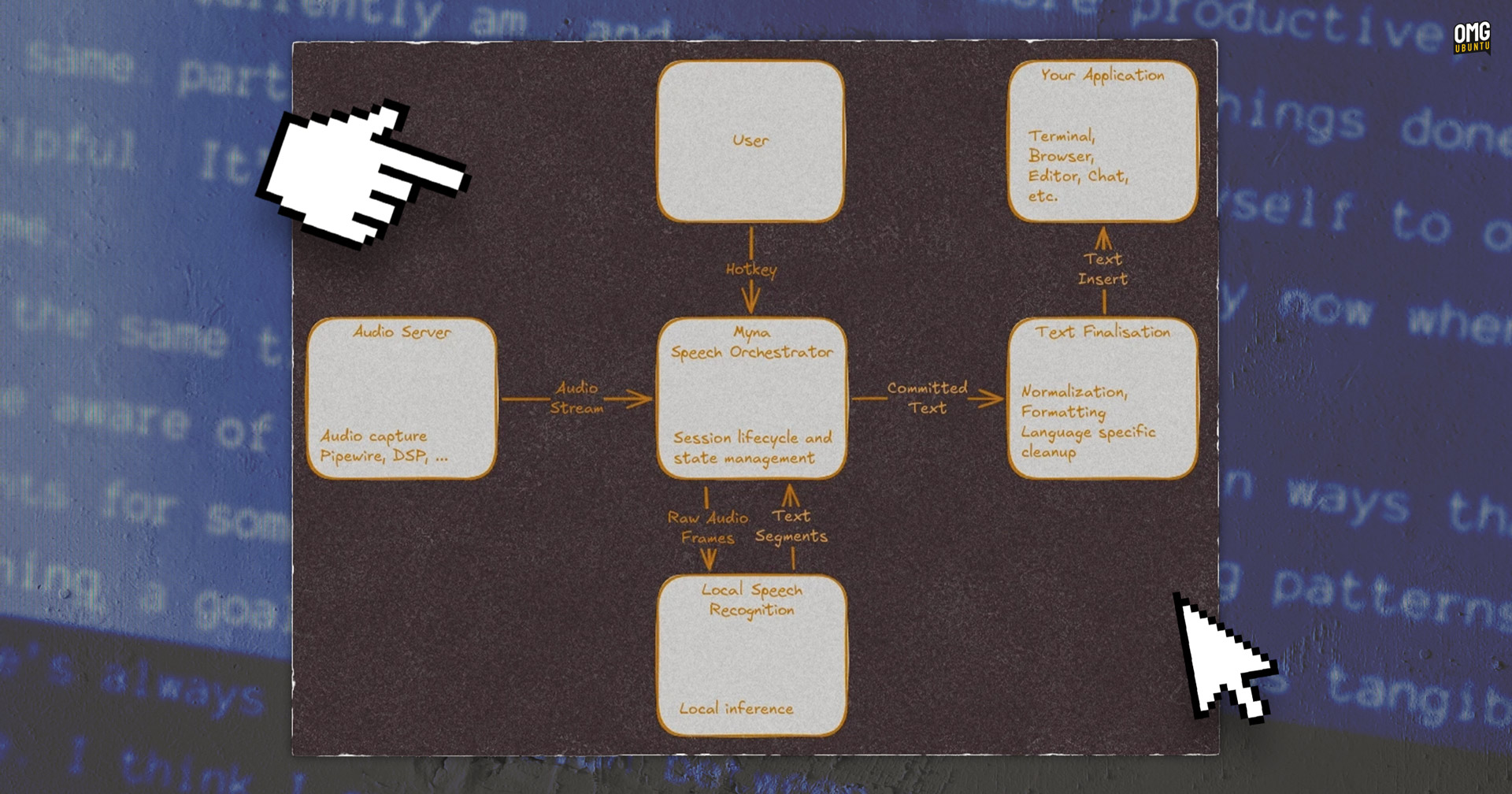
So how does it work? The Myna GitHub details the spec: a sandboxed Inference Snap (AI model) processes audio; Myna, a speech orchestrator, manages when to listen, passes audio to the model to be transcribed, passes the text back to the app you intend. Oh, and all audio is processed in memory, before being junked.
Is this something people will actually use? No-one is going to want dictate bash commands and file paths to their terminal for fun (the novelty of that lasts 1m 10s exactly). For long-form spiel, speech-to-text is loved by people who love the sound of their own voice talk faster than they type.
Still sounds niche. Put aside productivitymaxxing scenes tech bros tout in their VC pitches as the real day-to-day benefit for this is in accessibility. Text-to-speech tools on Ubuntu aren’t renowned for being great. If the AI boom means they improve, that’s a good thing.
English only? No, though language coverage depends on which AI model Myna uses (they can be swapped out based on hardware capabilities). Canonical’s looking at Whisper, Nvidia’s Nemotron, Parakeet and Qwen3-ASR. Many of these are multilingual.
I’m gonna need a big GPU to transcribe “lol”, aren’t I… It’ll help! Nemotron is NVIDIA-GPU only, Qwen3-ASR is CPU only, Whisper can run on both (and has the widest language coverage), some can use NPUs where available. It’ll depend on model and hardware, and the Myna setup will select accordingly.
But Myna isn’t a voice assistant, right? Not yet. Voice commands, desktop control, wake words and continuous listening are out of scope – for now. Canonical says it wants to focus on getting the basics right first.
That’ll be a first. Woah now, r/linux! ;)
Why’s it called myna? The myna bird is known for mimicking human speech (eerily well) so the name is a nod to that. Though here, Myna doesn’t mimic you, it just puts your words in the right box, which is a division of labour the name doesn’t capture, but hey: that’s only a myna quibble1.
My-nah; Ubuntu will let me opt-out, right? Mercifully, yes. AI features in Ubuntu rely on inference snaps, i.e., AI models that could be too big to fit in the OS image. You’ll be able to remove them. AI weariness and workslop fatigue is real thing, so it might be cathartic to type sudo snap remove all-the-ai.
Type? Surely you mean speak? Droll.
Do say: “Better dictation on Linux, at last!”.
Don’t say: “Hey Myna…” *pause* “…reorder loo roll”.
This is part of our Explainer format, where we chat through the Why, How and, more often, the Whatever without without the hype and jargon.
- Myna/minor, get it? No? Tough crowd. ↩︎