

As you may have heard, Ubuntu 25.10 on RISC-V will only run on devices with RVA23 profile extensions, a change made to allow the distro to take full advantage of newer hardware capabilities without backwards-looking compromise.
But if you’re worried that Ubuntu’s pivot to the RISC-V RVA23 profile would leave you without hardware to run it on (since, right now, no RVA23 devices are available) you can relax a little as a slate of RVA23-compatible chips are due to launch in 2026 – and some this year.
Given the lack of hardware on sale right now, some have questioned the move by Canonical. Yet, it didn’t happen in a vacuum. Its engineers have access to development hardware and close partnerships with silicon vendors. Not on sale doesn’t mean they don’t exist.
New RVA23 Hardware on the Way
A number of newer, high-performance RISC-V processors with RVA23 profile extensions (which include hypervisor support, opening up new opportunities for this nascent architecture) were, per a report from CNX Software‘s Jean-Luc Aufranc, showcased at the recent RISC-V Summit in China.
The UltraRISC UR-DP1000 ITX motherboard, Zhihe A210 SoC, and SpacemIT K3 SoC are expected to launch this year. While details are still a little vague on exact hardware make up.
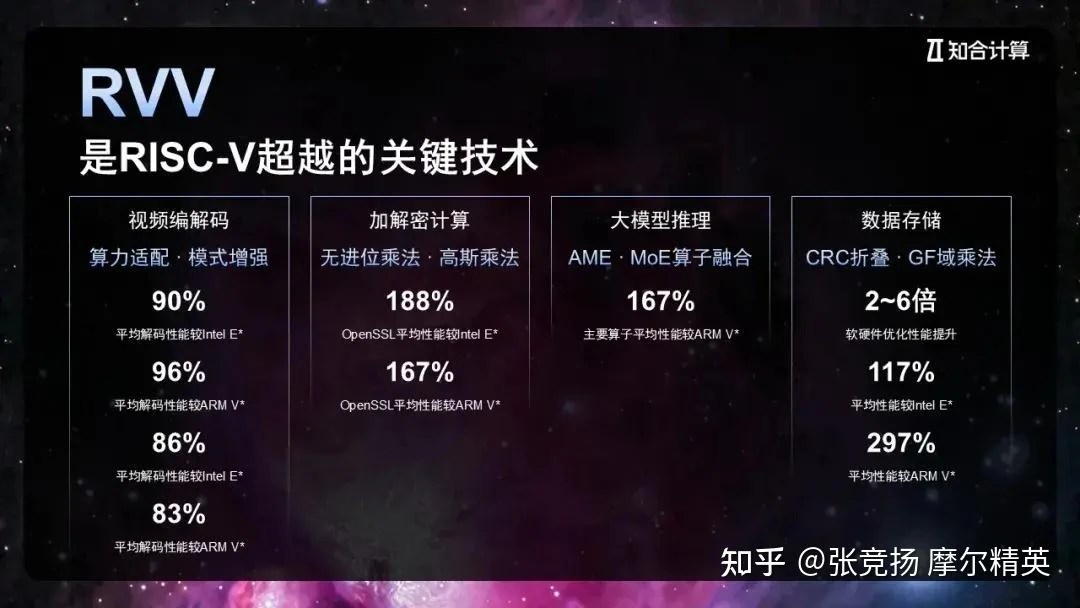
The Zhihe A210 is interesting in that it boasts support for all mandatory and optional extension in the RVA23 profile set (which, crucially, includes the Hypervisor and Vector extensions that have people excited) as well as 123 other official RISC-V extensions.
Zhihe’s marketing makes a big point of the A210’s Vector (RVV) extension performance (see the screen grab from their social media above) claiming its on par with, and sometimes beat, Intel and ARM in certain tasks.
It is precisely those demanding workloads, such as video encoding/decoding and running LLMs, that underscore why Ubuntu is choosing to focusing its desktop and server efforts on RVA23 going forward. The performance uptick is real, and it’s what’s needed.
Of course, it’s not just newer upstarts involved. Familiar names are embracing RVA23 too.
SpacemIT is well known to RISC-V users. It’s SoCs are used in a variety of boards and projects, including the MilkV-Mars, Banana Pi BPI-CM6, and recent Orange Pi R2S. The upcoming K3 is to be based around 8 X100 cores, and offer full RVA23 extension support.
Canonical was at the RISC-V Summit to showcase Ubuntu’s role on RISC-V, as well as demo 24.04 LTS running on the new, powerful yet non-RVA23 ESWIN Computing EBC77 board I covered a few weeks back.
What About Existing RVA20 Users?
For the avoidance of doubt, Ubuntu’s pivot towards RVA23 does’t abandon those with RISC-V RVA20 devices. Those remain supported by Ubuntu 24.04 LTS. RISC-V users are task-oriented, and care more about being able to do a task, than which version of Ubuntu they are using to do it!
But as high-performance RISC-V SoCs, single-board computers, ITX motherboard and compute modules become more in demand, pricing will come down – the potential for RISC-V in areas outside of small, embedded devices almost certain to soar.